Starting strength training later in life is not a watered-down version of what younger athletes do. It is the same principles with better judgment: start where you are, add slowly, and treat recovery as part of the program.
Begin with the joints, not the bar
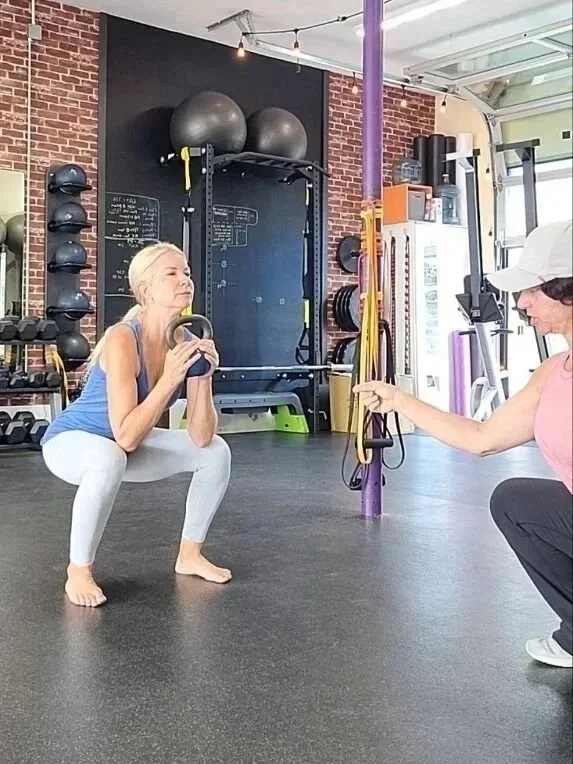
The first job is not to find your maximum. It is to find positions you can hold without compensation. Can you squat to a comfortable depth with your heels down? Can you hinge without your back rounding? Can you reach overhead without your ribs flaring? If not, those are the first projects — not a heavier deadlift.
A coach is useful here because the difference between “a bit stiff” and “a position that will cause trouble under load” is hard to see in your own mirror. A short assessment can save months of guessing.
Pick four patterns and repeat them
- Squat: a goblet squat or box squat you can control.
- Hinge: a kettlebell deadlift or hip bridge, ribs down.
- Push: a floor press, incline press or push-up variation.
- Pull: a row or band pull-apart with a deliberate squeeze.
- Carry: a suitcase or farmer carry for trunk and grip.
Two sessions a week is enough to start. Keep each session to five or six working sets in total if you are new. You do not need to train every muscle from every angle in week one; you need to show up again next week.
Leave two reps in reserve
For the first month, finish each set feeling as though you could have done two or three more clean reps. That is not laziness. It is how you accumulate practice without accumulating so much fatigue that the next session suffers.
Add reps before you add weight. When you can do the top of your rep range with good form and still have room, increase the load a small step. A 5 lb jump on a dumbbell is a real jump; treat it that way.
Recovery is part of the program
Sleep, food and walking matter more than the perfect exercise selection. Soreness that lingers for four days is information: the session was probably too much, or the week did not leave enough room to adapt. Back off rather than pushing through and losing a fortnight.
The best program at forty is the one you can still be doing at fifty.
What week one might look like
Warm up with five minutes of easy movement. Do a goblet squat, a kettlebell deadlift, an incline push-up and a row. Two or three sets each, stopping well short of failure. Finish with a short carry and a couple of minutes of breathing. That is a complete session. Repeat it twice that week, then add a small amount of load or a rep the following week.
If you have a history of back pain, a previous injury or a health condition that affects exercise, get cleared by your provider and tell your coach what you are managing. At EWB, pain relief and injury support are part of the personal training approach, so the plan can be built around the body you actually have.
Strength after forty is not about proving anything. It is about keeping the things you love to do available for longer — lifting a grandchild, carrying a board, hiking a trail, getting off the floor without a plan. Start smaller than you think you need to, and be consistent longer than feels exciting.
Find your format
Answer five questions and get a sensible starting point: personal training, small groups, recovery work or nutrition support.